customer story
Bellrock Safety
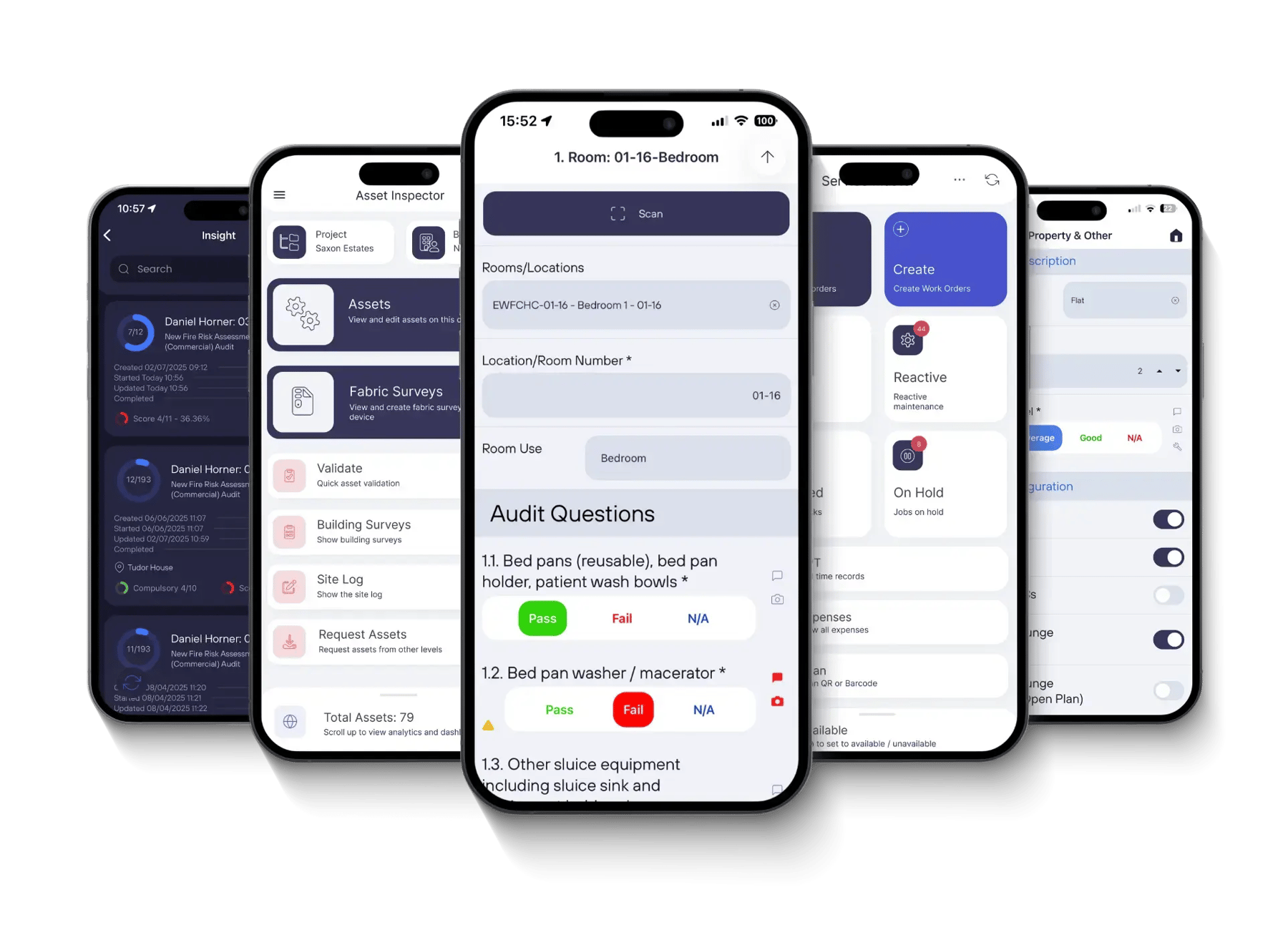
Bellrock digitised safety audits with Mobiess, cutting inspection time by 50%, removing paper, and gaining real-time compliance insight across estates.
A mobile-first inspection platform that eliminates manual processes and drives consistent, quality reporting.
An industry-leading mobile asset data collection and condition surveying software for FM.
A mobile field service and job management platform, agnostic of any master CAFM, designed for integration.
Fire Safety - digitise and streamline fire safety reporting, ensuring everything's tracked, evidenced and compliant.

The use of barcodes for identifying assets has been revolutionary in helping businesses improve data accuracy, and quality. Learn why your organisation should implement Barcodes or QR codes with your asset management system.
With the rise of cloud-based asset management tools, Barcodes and QR codes have become a cost-effective way to businesses of all sizes to manage and track their physical assets? Whether it's being used for inventory and stock control or lifecycle management, they reduce long-term costs and allows software to utilise them as much as possible.
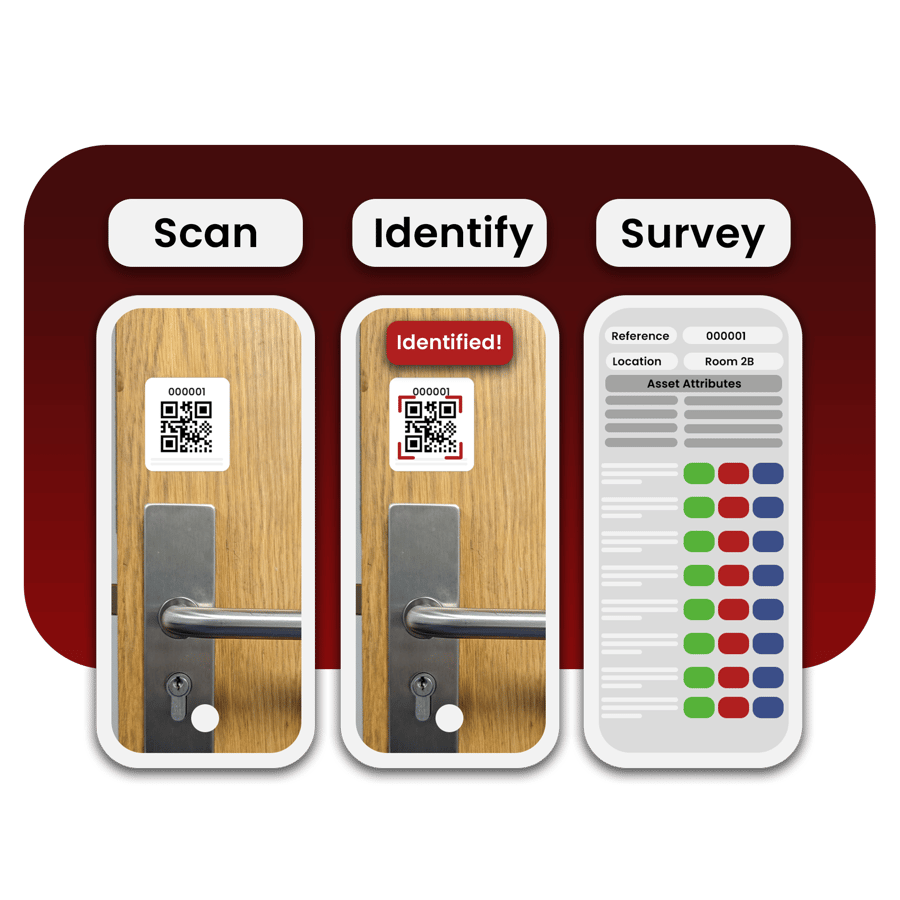
QR Codes are a simple but effective way to identify assets, and fire doors. A QR Code contains data which can be scanned using a mobile phone (which typically have inbuilt cameras which can be used to scan and open up the data held within the QR Code.)
There is a common misunderstanding that scanning a QR Code solely opens up a URL – however this is not true. QR Codes can store not only URLs, but also values like an identification number for assets too.
Usually, a simple number sequence is used to identify each individual asset within a building, the QR Code simply contains this reference.
The complexity when deploying asset labelling can vary as per organisation or customer requirements, for example a fire door might just be referenced “FD00001”, or perhaps prefix it to be more detailed, for instance: A-000127 (This could refer to “Building A” and asset number “000127”). This is completely up to you and your supplier when ordering the sequential asset labels.
Mobiess is a leading mobile data collection platform, containing a robust auditing and reporting engine built to allow organisations to manage almost any type of audit or inspection, enables teams to collect data faster, more efficiently, and with a greater level of consistency and quality, while digitising and automating reporting.
Extend your current mobile capabilities and streamline your on-site data capture.
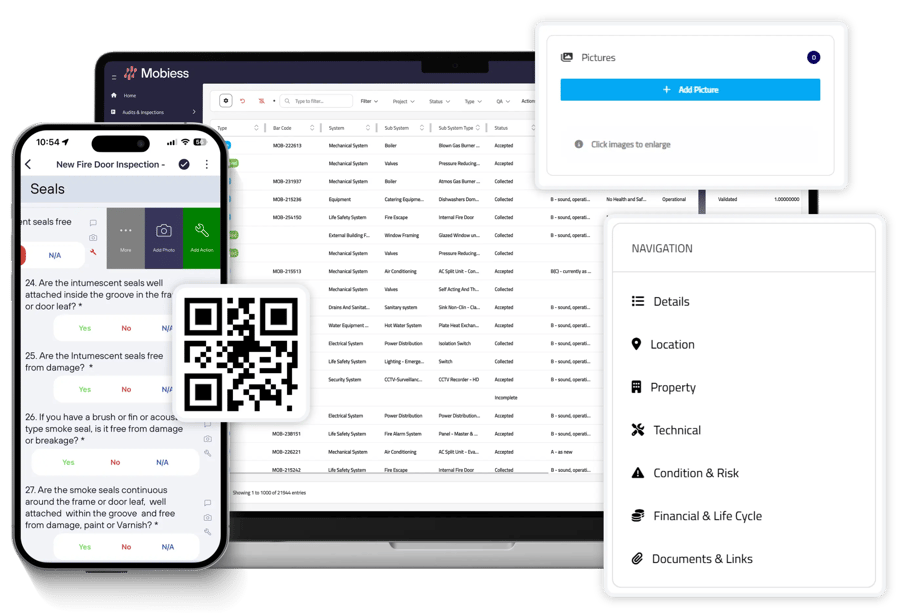
Asset tagging opens up a wide range of data-collection and tracking possibilities, particularly when used alongside a computerised system. By attaching QR Code tags to assets, for example: fire doors, you can gather a wide range of data and record it in a digitised fixed asset register.
Having complete visibility into which assets are non-functional and require maintenance, reduces inefficiencies, and maximizes effective utilization of business resources. Implementing QR Codes / Barcodes with an asset management system onto your Fire Doors is an effective replacement for time-consuming manual methods such as pen and paper.
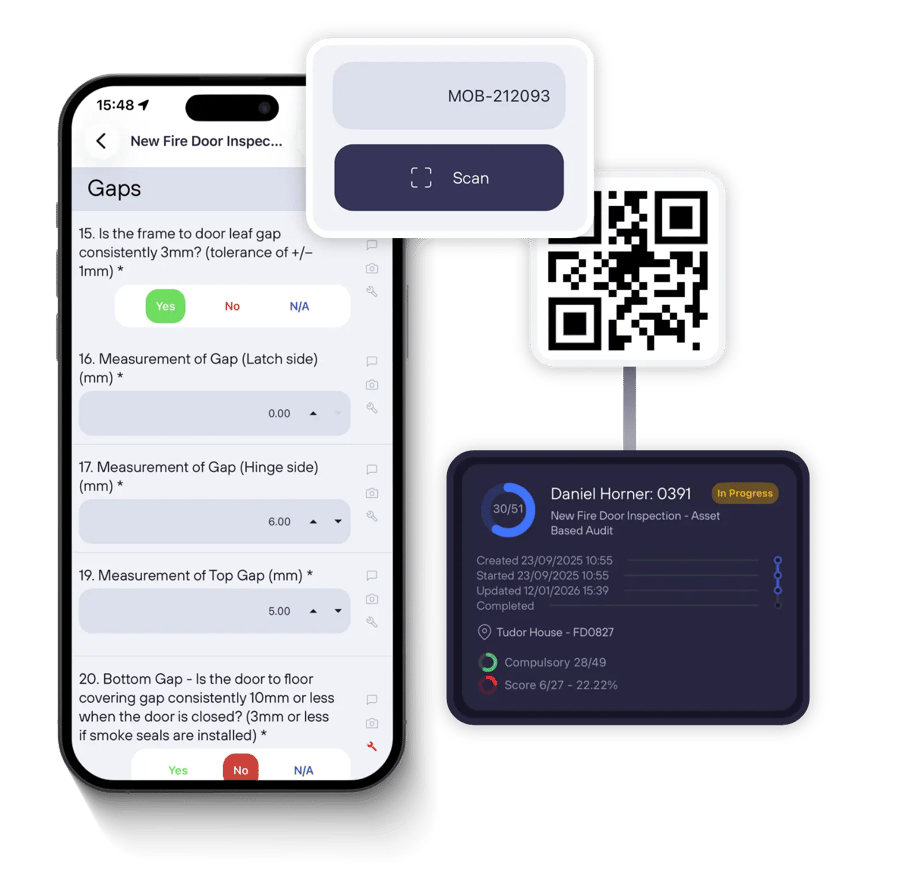
Having a structured approach to tagging and coding assets, allows you to treat each fire door as an individual asset. Completing your fire door inspections using asset tagging and a digital system increases the level of consistency and quality of that data. This in turn gives you the opportunity to build and maintain a detailed real time asset register per client and per site. The fact that a door is assigned a unique identification number sets each door apart, allowing them to be instantly recognisable in an asset management system. This will also help processes such as maintenance and inspections and assigning surveys to them.
.jpg?width=900&name=QR-Codes-for-Firedoors-Information%20(1).jpg)
Mobiess is a software supplier, and we do not supply Barcodes or QR Codes, our platform just utilises and supports the scanning of them for identification or asset data collection purposes.
QR Code stickers are available in a wide range of sizes, quality and durability – as well as sequential number or variable data options.
Whilst we don't supply asset labels, Mobiess are happy to suggest potential suppliers for customers looking to get underway with asset labelling.
QR Print Tech is a leading UK based QR code solutions specialist. From bespoke and custom designed labels to off the shelf sequential numbering, QR Print Tech provide a range of solutions for businesses looking to implement QR Codes and Asset Tagging, rapidly growing in the Fire Safety industry, supplying QR Code labels for organisations to tag and code their fire doors.
As an industry-leading mobile data collection software provider, Mobiess empowers organisations to collect and manage asset data with more efficiency. From property owners with a small number of buildings, to commercial asset collection agencies whose technicians run multiple projects each with hundreds or thousands of properties per project, Mobiess supports a wide range of organisations with their mobile data collection strategy.
Whether this is collecting and managing the full lifecycle of M&E Assets, providing fire door inspections, or conducting asset-based inspections Mobiess is able to accommodate your requirements via our suite of advanced software solutions.
Bellrock Technologies is a leading voice in prop tech. Browse our latest news, trends, and customer stories.

Bellrock digitised safety audits with Mobiess, cutting inspection time by 50%, removing paper, and gaining real-time compliance insight across estates.
KBR use Mobiess to integrate mobile data capture into their FM platform, enabling real-time work orders, audits, and scalable service delivery across contracts.

Mobiess is used to conduct and completely digitise all the site inspections and roof inspections in Bellrock Group's Consulting division
An asset taxonomy is a structured way for categorising and organising assets into a hierarchy, and aims to provide a standardised way of classifying to help organisations track and manage their assets effectively, make informed decisions about investments and divestments and report on their financial performance. If you neglect your asset hierarchies, you're inviting inefficiency, poor service delivery, and financial penalties. Rubbish in... Rubbish out!
Defining and categorising assets properly
An asset taxonomy is a structured way for categorising and organising assets into a hierarchy, and aims to provide a standardised way of classifying to help organisations track and manage their assets effectively, make informed decisions about investments and divestments, enabling them to accurately report on their financial performance. If you neglect your asset hierarchies, you're inviting inefficiency, poor service delivery, and financial penalties. Rubbish in... Rubbish out!
The underlying issues with asset registers in FM
Does your asset hierarchy enforce consistent naming conventions across all sites and systems in your asset register? Imagine you're tracking faults across multiple sites and systems, but there's no standard way of recording assets. If an asset is logged as "Air Handling Unit 1" in one system and "AHU_01" in another, then your asset hierarchy is already broken.
Where to start?
These M&E asset surveying organisations will typically use asset data capture software like Mobiess Asset Inspector as the mobile tool to perform data collection and QA services. High quality data in asset registers are more crucial than ever in today's market - and utilising data-driven mobile-first asset data collection software allows organisations to build strong consistent asset registers that stand up to scrutiny.
Simply put, free-text kills data quality. While it's necessary in some cases, if overused (which it often is), it creates a messy unstructured method of data collection, leading to inconsistent responses across teams, increased difficulty in analysing reports, and more errors such as spelling mistakes.
Simply put, free-text kills data quality.
While it's necessary in some cases, if overused (which it often is), it creates a messy unstructured method of data collection, leading to inconsistent responses across teams, increased difficulty in analysing reports, and more errors such as spelling mistakes.
A widespread problem
When logging issues and defects, imagine having to manually write out locations, descriptions and defects every single time, for every single issue. You're spending hours logging the same task, the same issue - repeating yourself over and over again.
You can streamline the majority of these processes - review what you already have, and standardise the collated information into something useful to improve your productivity.
Where to start
Think about how you can enhance what you have, not just copy the same word document onto a digital system. Review the processes you have, technology you use, and then how you display this - what's the outcome: radio button options, data-driven picklists.
Spreadsheets and paper can't enforce structure, but technology like Mobiess can - utilise a digital system and make sure structured data collection is the only option across your organisation.
It's not about replicating what you have. It's about taking a step forward and actually improving the way you capture, QA and manage data.
Stop capturing everything, start capturing what matters. More data does not equal better data Some teams collect too much data which they'll never use, others collect too little, missing what actually matters. Don't confuse volume with value - this can lead to chaotic asset registers, wasted time and wasted effort, irrelevant data in reports, a "not quite golden thread" of compliance. Focus on purpose-built structured data capture, using a reliable data capture software provider.
Stop capturing everything, start capturing what matters. More data does not equal better data.
Some teams collect too much data which they'll never use, others collect too little, missing what actually matters. Don't confuse volume with value - this can lead to chaotic asset registers, wasted time and wasted effort, irrelevant data in reports, a "not quite golden thread" of compliance.
Focus on purpose-built structured data capture, using a reliable data capture software provider.
Is all of your data actually useful?
Whether it's inspections, asset surveys or work orders, every field collected, should contribute towards compliance, operational decisions or meeting customer requirements. Often enough the data you collect will be used downstream in reporting or CAFM systems, feeding trend analysis and issue resolution.
It's not about collecting data "just in case", it's about capturing meaningful information that supports specific structured outcomes. If it's not useful, don't waste your time collecting it. Using hierarchical and rules-based asset data capture software like Mobiess helps you define the exact fields needed across multiple sites, projects, systems and asset types.
Stop cutting corners
Don't starve your systems of the data it needs, just to cut costs. It's a common issue across the FM industry that organisations don't collect good quality data. It's often substandard, or "of limited use". Ensure that the right data is captured at the right time, by the right people, in the right way.
The value of data lies in its relevance, consistency and accuracy. Not it's quantity.
Preparing your data for end use. Data collection isn't the goal, usability is. Hand over a database rather than an excel file. Consider what format your client wants the data in, and what they want to achieve. Encapsulate all the asset data and photo evidence together Do they want to analyse the data for forward maintenance registers, identify remedial works or gain a summary of assets by condition, risk or criticality?
Preparing your data for end use. Data collection isn't the goal, usability is.
Hand over a database rather than an excel file. Consider what format your client wants the data in, and what they want to achieve. Encapsulate all the asset data and photo evidence together
Do they want to analyse the data for forward maintenance registers, identify remedial works or gain a summary of assets by condition, risk or criticality?
Educating your CAFM system
A CAFM system is only as smart as the data you feed it. Have you considered it feeding it FMR data, lifecycle data, hazard data, permits required information, and any immediate repair information? CAFM and IWMS systems need to be continuously educated, make sure you're constantly updating it with accurate information.
Data Maintenance
Don't wait for handbacks or audits to start updating your asset register. Spread the risk by carrying out asset audits as part of your operational processes. Empower your engineers with the right tools and data collection software to perform asset condition verification or validation exercises, and inspections with ease, whenever they're on site - 1 audit every 5 years is not fit for purpose any more.
Speak to our team and see how Mobiess can streamline your data capture and reporting processes through our dedicated mobile inspections, asset and work order management platform.